
Research: Growing threats to India’s Madras hedgehog
7th October 2026
A major conservation project, supported by PTES, has uncovered new evidence about the little-known Madras Hedgehog, revealing widespread habitat loss, pesticide exposure and road mortality, while engaging thousands of local people in its protection.
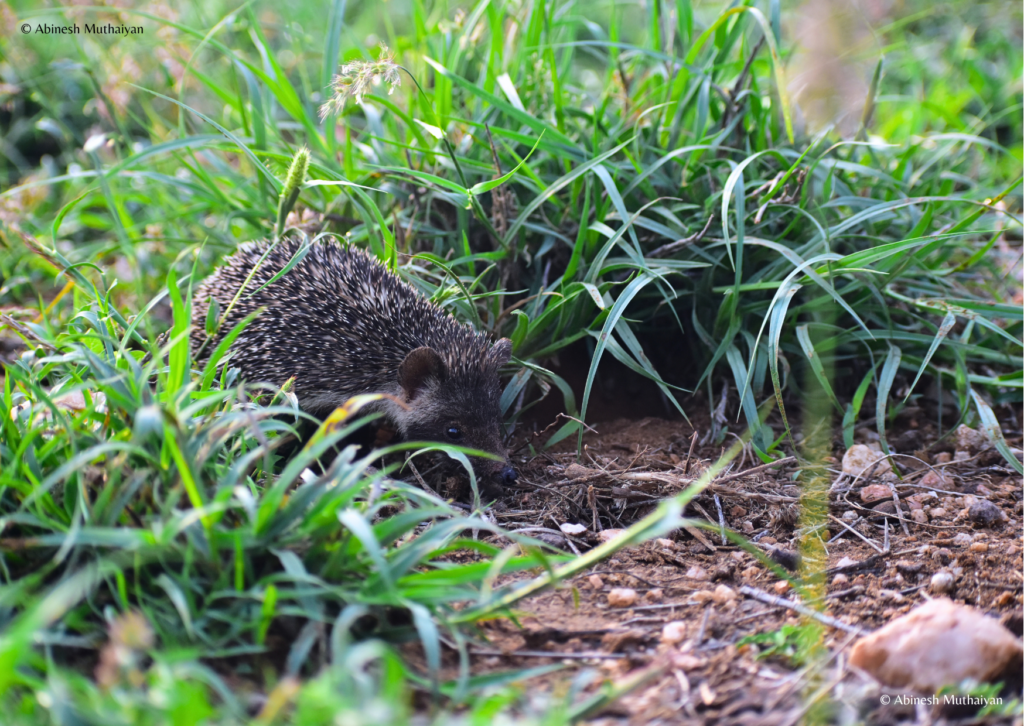
The Madras Hedgehog (Paraechinus nudiventris) is an elusive hedgehog found only in mainland India. It is one of four hedgehog species endemic to India but has received very little scientific attention despite being one of the country’s most range-restricted hedgehog species.
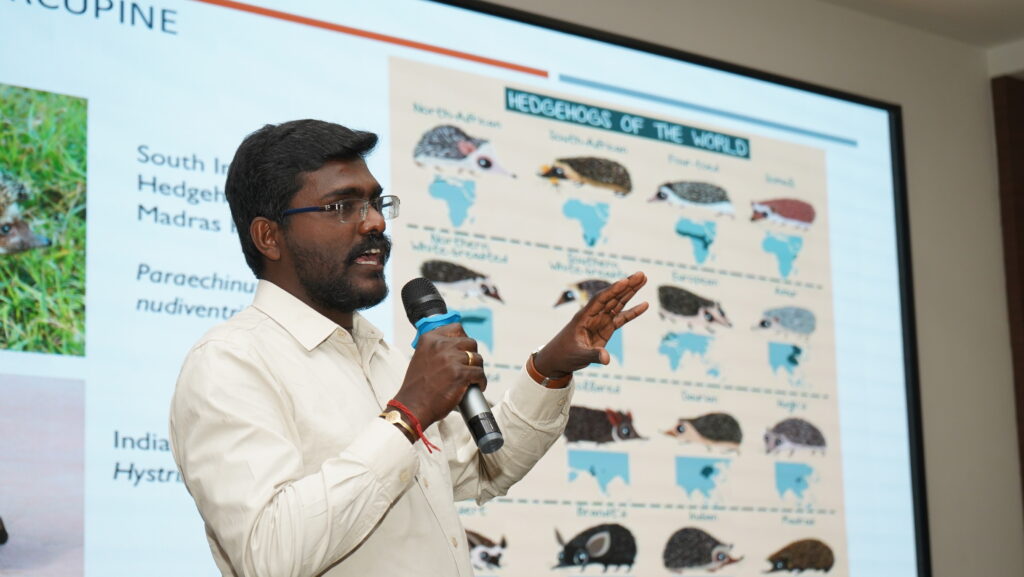
Now, a two-year conservation project in Tamil Nadu has produced the first substantial dataset on the species, providing new insights into where the hedgehogs live, the threats they face and how local communities view them. Led by Dr Brawin Kumar of Action for Community Transformation India Trust (ACTIF Trust), the project initially focused on studying the hedgehogs around Tiruppur District. It subsequently expanded across the wider Kangeyam–Tiruppur area and into Salem and Erode districts. More than 3,600 people across over 180 villages contributed to the wider programme, helping researchers build what the project describes as the largest community-ecology dataset yet assembled for the species.
Shrinking habitat
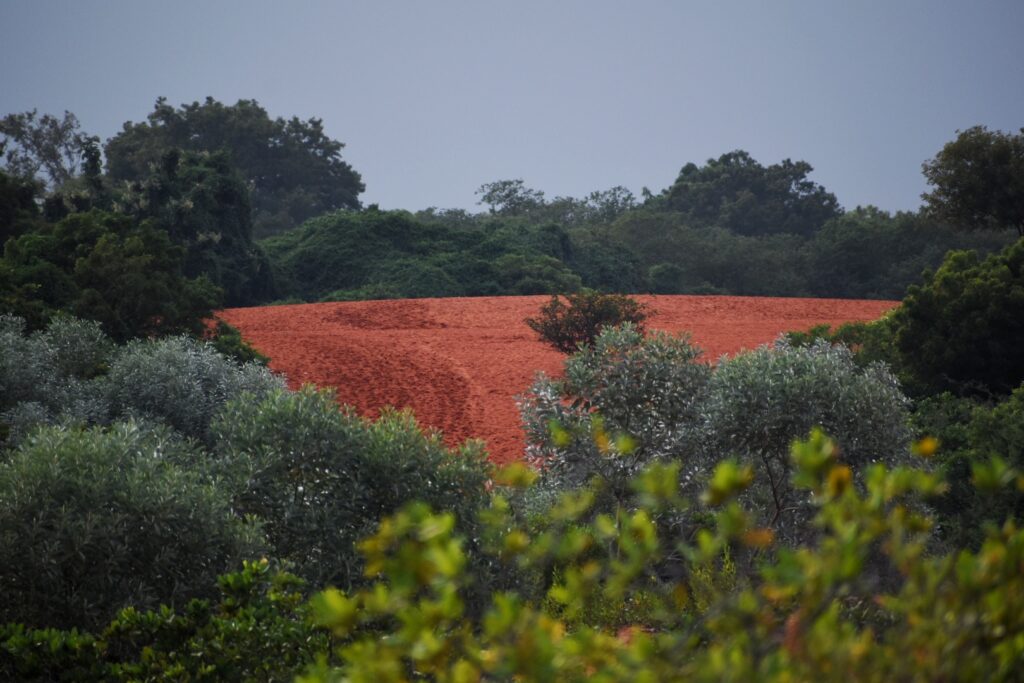
One of the most striking findings concerns the rapid transformation of the hedgehog’s habitat. The Madras Hedgehog is associated with semi-arid landscapes containing scrubland, rocky terrain and agriculture. But in Erode District, analysis found that scrub forest, which is considered a critical habitat for the species, declined by 99.6% between 2005 and 2016. Cropland also fell by 32.2%, while mining increased by 180.2%. Researchers say the findings provide concrete evidence linking major land-use changes with local hedgehog declines.
Other threats identified during the project included habitat fragmentation, road deaths, agricultural intensification, predation by free-ranging dogs and hunting for use in traditional medicine. In Salem District, road mortality was the most frequently reported threat.
Raising awareness
With the hedgehog difficult to find and study directly, the project turned to local communities to build a picture of its distribution. A survey of 967 people across 61 villages in the Kangeyam and Tiruppur areas found that sightings were strongly associated with particular habitats. Agricultural land accounted for 56.4% of reported sightings and scrubland accounted for 51.7%. The vast majority of sightings occurred during the Northeast monsoon, between October and December.
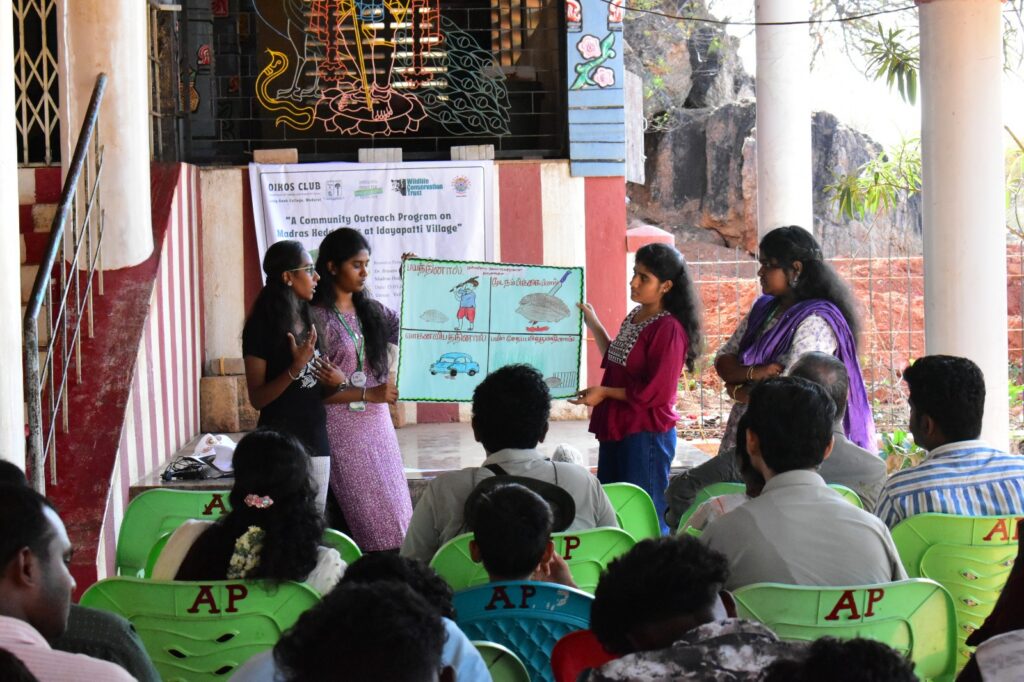
The project also delivered 107 awareness programmes during its first year, reaching more than 5,100 residents and 2,800 school students. A network of 200 college volunteers from 15 institutions subsequently extended outreach and data collection into another 46 villages.
A youth-led “Hedgehog Hero” network was established in several communities, with volunteers helping raise awareness among villagers, farmers, hunters and truck drivers. More than 300 people across 19 areas were reached through the initiative, while hedgehog awareness books were distributed to 79 villages.
New health threats uncovered
The project has also revealed previously undocumented health and environmental concerns about the Madras hedgehog. In collaboration with the University of Oxford’s Wildlife Conservation Research Unit and India’s Indian Council for Medical Research–Vector Control Research Centre, researchers examined tick infestations on hedgehogs. They recorded 167 ticks from 22 hedgehogs, identifying three tick species. Separately, one hedgehog from an urban grassland area was carrying an extraordinary 161 ticks, representing all stages of the tick life cycle. Researchers say the finding has potential implications for both wildlife and public health.
The research also produced the first documented evidence of pesticide exposure in wild Madras Hedgehogs. An analysis of five road-killed animals detected several compounds, including the banned pesticide endosulfan. Researchers also established the first microbiological baseline for the species, detecting 11 microbes from eight locations on a wild female. Some included bacteria of zoonotic relevance, including Salmonella and E. coli.

A glimpse into hedgehog behaviour
The project even produced a remarkable first record of behaviour in the species. During nocturnal fieldwork, a male Madras Hedgehog was observed eating an Indian red scorpion before self-anointing itself with the toxic latex of the crown flower.

Conservation work continues
Not everything planned for the project could be completed. Researchers had intended to radio-tag four hedgehogs and track their movements to estimate home ranges, but prolonged problems importing radio-tagging equipment prevented the work from being completed during the research period. Instead, the team redirected its efforts towards large-scale surveys, habitat analysis and health research, significantly expanding the project’s scientific output.
A proposed community conservation and rescue centre in Tiruppur has also yet to be established and remains a priority for the next phase.
The researchers now hope to expand population studies using camera traps and occupancy modelling, investigate breeding and juvenile survival, study the species’ diet and genetic connectivity, and examine the demographics of roadkill. They also plan to expand the Hedgehog Hero network and establish community-led conservation groups across priority areas.
The project has helped transform the Madras Hedgehog from a poorly understood species into one with an emerging scientific and community conservation network. For Dr Kumar and his collaborators, the next challenge is turning that growing evidence base into long-term protection for the hedgehog.